
Relocating to a new country can be both exciting and challenging, especially when it comes to finding a place to live. As a new migrant to Australia, securing accommodation is one of the first and most important steps in your journey. This guide will provide a comprehensive overview of the accommodation process in Australia, from short-term rentals to long-term leases, and what factors to consider before signing a contract.
1. Types of accommodation available
Australia offers a variety of housing options, depending on your needs, budget, and location preference. Here are some popular types of accommodations for migrants:
| Accommodation Type | Description |
|---|---|
| Shared House | Renting a room in a shared house with other tenants |
| Studio Apartment | Small, self-contained unit, ideal for singles or couples |
| 1-Bedroom Apartment | Private apartment with one bedroom, suitable for individuals or couples |
| 2-Bedroom Apartment | Private apartment with two bedrooms, suitable for small families |
| House Rental | A full house, generally more spacious and suitable for families |
Rents vary a lot between cities and suburbs, so check current listings for the area you’re considering.
2. Short-term vs. long-term accommodation
As a new arrival, you may want to start with short-term accommodation while you familiarize yourself with the area and search for long-term options.
- Short-term accommodation: Typically includes furnished apartments, hostels, and Airbnb options. This is ideal if you’re still exploring neighborhoods or waiting for a more permanent residence.
- Long-term accommodation: Commonly available through private rentals or shared housing. These usually need you to sign a lease for a fixed term.
3. Key factors to consider when choosing accommodation
Location
- Proximity to work and public transport: Consider access to public transport, especially if you don’t plan on owning a car.
- Community facilities: Look for areas with nearby amenities like supermarkets, schools, and healthcare centers if you have a family.
Budget
- Deposit and initial costs: You’ll usually pay a bond (security deposit). The maximum is set by each state’s rules. You’ll also need to budget for rent in advance and any utility setup fees.
Lease terms
- Length of lease: Check the lease’s fixed term before you sign. Review the lease for terms on termination, maintenance responsibilities, and bond (security deposit) details.
- Furnished vs. unfurnished: Some accommodations come furnished, but unfurnished rentals are more common and offer flexibility for long-term plans.
4. Steps to secure accommodation in Australia
- Set your budget and requirements: Determine your preferred location, type of housing, and budget.
- Start your search online: Popular websites like mynewaustralianlife.com, and Facebook Marketplace offer up-to-date listings.
- Arrange property inspections: Attend open house inspections to view the properties in person.
- Submit your application: Prepare a rental application, including references, identification, and proof of income.
- Negotiate and sign lease: Once approved, review the lease agreement carefully, negotiate terms if necessary, and sign the lease.
5. Top cities for migrants and their average rent
To help you decide on a location, here is a chart showing the average weekly rent in popular Australian cities for a 1-bedroom apartment.
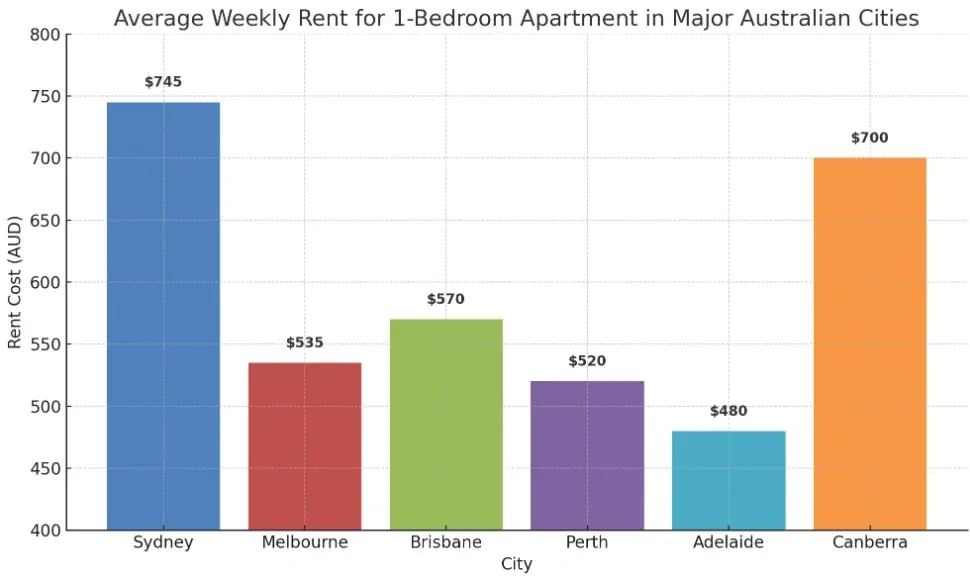
Note: Rent prices are approximate and subject to change.
6. Tips for migrants to secure accommodation quickly
- Prepare your documents: Landlords may require identification, proof of income, and references, so have these ready to expedite the process.
- Consider living with roommates: Shared accommodations are often more affordable and can be a way to meet new people.
- Be flexible with location: Expanding your search area may reveal more affordable options.
- Explore alternative housing: Student housing and co-living spaces offer flexible options for short-term stays.
Common FAQs for new migrants renting in Australia
- What is the average rental bond amount?
- Bonds typically equal four weeks of rent, held as a security deposit for the property.
- Are utilities included in rent?
- Utilities like electricity, gas, and internet are often separate. Clarify this with your landlord or rental agency.
- How does rental payment work?
- Most rentals require rent payments weekly, fortnightly, or monthly. Payments are typically made via bank transfer.
Organizations and companies offering affordable housing in Australia
These organizations and companies play a crucial role in addressing the housing needs of low- to moderate-income earners, including migrants, by offering various affordable housing options and home starter support services across Australia.
1. National Affordable Housing Consortium (NAHC)
NAHC is a not-for-profit organization dedicated to developing and managing affordable housing across Australia. They partner with various stakeholders, including governments, community housing providers, and private sector investors, to deliver affordable rental and homeownership opportunities for low- to moderate-income earners.
Website: https://www.nahc.org.au/
2. Community housing limited (CHL)
CHL is a national and international housing provider that offers long-term rental housing to people in need. They focus on providing affordable and sustainable housing solutions, including social housing, affordable rental housing, and specialized housing services for vulnerable populations.
Website: https://chl.org.au/
3. Mission Australia housing
Mission Australia Housing is a community housing provider that manages and develops affordable and social housing. They offer rental housing for individuals and families on low incomes and provide support services to help tenants maintain their tenancies and improve their well-being.
Website: https://www.missionaustralia.com.au/housing
4. St. Vincent de Paul Society (Vinnies) housing
Vinnies Housing provides affordable rental housing and homelessness services. They operate a range of housing programs, including crisis accommodation, transitional housing, and long-term affordable rental housing, aimed at supporting individuals and families experiencing or at risk of homelessness.
5. Haven; home, safe
Haven; Home, Safe is a community housing organization that offers affordable housing and homelessness support services. They provide a range of housing options, including long-term affordable rentals, crisis accommodation, and support services to help individuals and families achieve stable housing.
Website: https://havenhomesafe.org.au/
6. Bridge housing
Bridge Housing is a community housing provider that delivers affordable rental housing and housing support services in Sydney and surrounding areas. They focus on providing safe, secure, and affordable housing options for low- to moderate-income households.
Website: https://bridgehousing.org.au/
7. Yarra Community Housing
Yarra Community Housing offers affordable and sustainable housing solutions in Victoria. They manage a range of housing options, including social housing, affordable rentals, and supported housing for people with special needs.
8. BaptistCare housing
BaptistCare Housing provides affordable housing and aged care services. They offer long-term rental housing for low-income earners, seniors, and people with disabilities, along with support services to enhance tenants’ quality of life.
Website: https://baptistcare.org.au/
9. Common equity housing limited (CEHL)
CEHL is a housing cooperative that provides affordable housing through a cooperative model. Tenants are members of the cooperative and have a say in the management of their housing. CEHL offers affordable rental housing and promotes community involvement and support.
Website: https://cehl.com.au/
10. Housing choices Australia
Housing Choices Australia is a not-for-profit housing provider that offers a range of affordable housing options, including social housing, affordable rentals, and supported housing for people with disabilities. They aim to create vibrant and inclusive communities by providing quality housing and support services.
Website: https://www.housingchoices.org.au/
Understanding affordable housing in Australia
Affordable housing refers to accommodation that is reasonably priced relative to an individual or household’s income, ensuring that residents can afford other essential expenses such as food, transportation, healthcare, and education. In Australia, housing affordability is typically measured by the proportion of income spent on housing costs. Generally, if a household spends more than 30% of its gross income on housing, it is considered to be experiencing housing stress.

The Australian housing market varies significantly across different regions, influenced by factors such as economic conditions, population growth, and housing supply. Major cities like Sydney and Melbourne are known for their high property prices, making it challenging for many, including migrants, to find affordable housing. In contrast, smaller cities and regional areas often offer more affordable housing options, though they may come with trade-offs such as fewer jobs and amenities.
Government and non-governmental organizations play a vital role in supporting affordable housing initiatives. Various programs and schemes are designed to assist low- to moderate-income earners, including migrants, in accessing affordable housing. Understanding these programs and how they work is essential for migrants looking to secure stable and affordable accommodation.
In summary, affordable housing is a cornerstone for the successful integration of migrants into Australian society. By understanding the dynamics of the housing market and the available settlement service support systems, migrants can make informed decisions and find suitable housing that meets their needs and budget.
Student accommodation in Melbourne
The Melbourne Central Business District is a vibrant hub of activity and offers a range of accommodation options to suit different budgets and lifestyles. However, it’s important to note that accommodation in the CBD tends to be more expensive than in outer suburbs.
- Apartments: The most common accommodation type in the CBD, offering a range of sizes and amenities. Prices vary significantly depending on the building’s age, size, and location. Expect to pay a premium for city views or modern apartments.
- Share houses: Less common in the CBD but can be a more affordable option. Shared apartments or houses can be found, especially in the fringe areas of the CBD.
- Student accommodation: Some universities offer accommodation options in or near the CBD. These might be more affordable for students but can have limited availability.
Cost of living in Melbourne
Living in the Melbourne CBD is generally more expensive than in other parts of the city. You can expect to pay more for:
- Rent: As mentioned above, apartments tend to be pricier in the CBD; however, if you are a skilled migrant, seeking assistance and support in settlement services to assist you in settling into your new home is more favorable.
- Food: While there’s a wide range of dining options, eating out or purchasing groceries can be more expensive compared to other areas.
- Transportation: While public transport is generally good, you might incur additional costs for taxis, rideshares, or parking if you own a car.
- Entertainment: The CBD offers a plethora of entertainment options, but tickets to shows, events, and attractions can be costly.
To offset the higher cost of living in the CBD, you can:
- Share accommodation: Renting a room in a shared apartment can significantly reduce costs.
- Cook at home: Prepare meals at home to save money on dining out.
- Utilize public transport: Walk, bike, or use public transport to reduce transportation costs.
- Take advantage of free events: Many free activities and events are available in the city.
Remember, these are general trends, and individual circumstances can vary. It’s always recommended to do thorough research and budgeting before moving to the Melbourne CBD.
Transportation in Melbourne CBD
The Melbourne CBD boasts an excellent public transportation network, making it easy to get around without a car.
- Trains: The Melbourne Metro and suburban train lines converge in the CBD, providing frequent and efficient service to various parts of the city and suburbs.
- Trams: The iconic Melbourne trams run through the city’s streets, offering a convenient way to explore the CBD and its surroundings.
- Buses: Complementing the train and tram network, buses provide additional connectivity within the CBD and to nearby suburbs.
While owning a car can be convenient, it’s often unnecessary in the CBD due to traffic congestion and high parking costs.

Studying options in Melbourne CBD
The Melbourne CBD is a hub for education, with several renowned universities and colleges offering a wide range of courses. Some of the prominent institutions with campuses in the CBD include:
- University of Melbourne: One of Australia’s leading universities, with a strong presence in the CBD.
- RMIT university: Offers a variety of courses and has a significant campus in the city center.
- Victoria university: Provides accessible higher education options with campuses in the CBD.
- TAFE institutes: Offer vocational and technical training courses.
Studying in the CBD offers the advantage of being immersed in a dynamic environment with access to libraries, research facilities, and career opportunities.
Student-friendly hostels and apartments in Melbourne CBD
While the CBD might be a bit pricey for students, there are a few options that can be considered student-friendly due to their amenities or location.
Student-friendly apartments
- UniLodge carlton: While not strictly in the CBD, it’s very close and offers student-specific accommodation with shared kitchen facilities.
- Illawarra hall: Another option near the CBD, offering accommodation for university students with shared amenities.
Student-friendly hostels
Hostels are generally more budget-friendly and offer a social atmosphere, which can be appealing to students.
- Base backpackers Melbourne: Located in the heart of the city, offers a mix of dorm rooms and private rooms.
- Habitat backpackers: Another centrally located hostel with a variety of room options.
- Space hotel & hostel: Situated near the CBD, offers a blend of hostel and hotel accommodations.
Remember: Prices can fluctuate, and it’s always a good idea to check for student discounts or promotions. Additionally, consider factors like location, amenities, and reviews when making your choice.
Importance of optimizing financial resources as a student in Melbourne.
Migrant students in Melbourne face unique challenges when it comes to accommodation and finances. They often arrive in a new country with limited financial resources and a need to balance academic pursuits with the demands of independent living.
Here’s a breakdown of why careful consideration of accommodation and cost of living is crucial for migrant students:
- Financial constraints: International students often rely on personal savings or student loans, necessitating careful budgeting. Wise accommodation choices can significantly impact overall expenses.
- Academic focus: A suitable living environment is essential for academic success. Students need a quiet and conducive space to study.
- Social integration: Sharing accommodation can provide opportunities to interact with other students, aiding in social integration and language acquisition.
- Safety and security: Choosing a safe neighborhood is paramount for personal well-being and peace of mind.
- Transportation costs: Proximity to the university and public transport options can influence accommodation choices and overall expenses.
- Long-term goals: Careful financial management can help students save for future expenses like textbooks, travel, or post-graduation plans.
By making informed decisions about accommodation and cost of living, migrant students can optimize their financial resources, enhance their academic performance, and enjoy a fulfilling student experience in Melbourne.